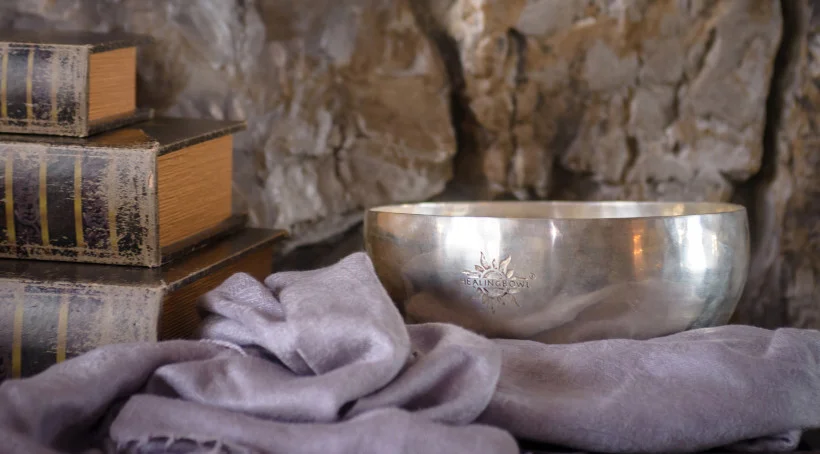
Crystal, cast, forged, and professional singing bowls. Methods of application.
Crystal, cast, forged, and professional singing bowls. Methods of application.
Today, singing bowls are used by enthusiasts who see them as “magical” tools, in sound healing practices, by health professionals — massage therapists, neurologists, rehabilitation specialists (who practice massage with singing bowls), psychotherapists, as well as by families for home use. We will explore why this method has gained popularity, which singing bowls are effective, and how to find the right approach to this method when it has practical value.
Singing Bowls: Science or Esoterics?
This question is fundamentally misguided, and we will explain why. If an object has existed since ancient times and we still encounter rituals involving it, there must be some reason to consider its potential benefits and value. However, this is not always justified. Take, for example, the vajra.
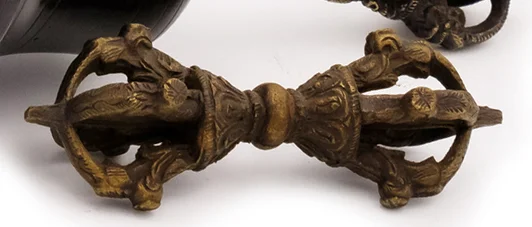
There are many legends about a divine weapon or a device capable of concentrating immense destructive energy. Today, the characteristic vajra object is popular as an esoteric symbol — for instance, in Hinduism and Buddhism. In Hinduism, it is an object of worship; in Buddhism, it is a ritual attribute symbolizing concentration, amplification of energy flow, and removal of obstacles. In reality, it does not function practically — it is merely symbolic, a ritual object. We know such a thing existed and roughly what it looked like, but we do not know how it was supposed to work.
Now consider the singing bowl. Because its construction is far simpler than that of a mythical divine weapon, its properties — sound and vibration — have been studied scientifically. Yet, ritual use by esoteric practitioners remains widespread. This is what is known as a cargo cult. Believers in a cargo cult may build fake airfields, “radio stations”, model airplanes, and other imitations of technological artifacts. The same applies to singing bowls: believers perform rituals. Ritualistic use implies superficial engagement, without deep understanding. There is little professionalism or genuine comprehension of the underlying processes, but much faith in miracles and misrepresentation. At least it helps keep traditions alive — for that, we are grateful. However, uninformed use of singing bowls can cause minor harm. The most common scenario is: beautiful, exotic, but useless. This is understandable: faith in miracles, romance, reluctance to critically examine facts, and desire for effortless success appeal to many — just like children love fairy tales.
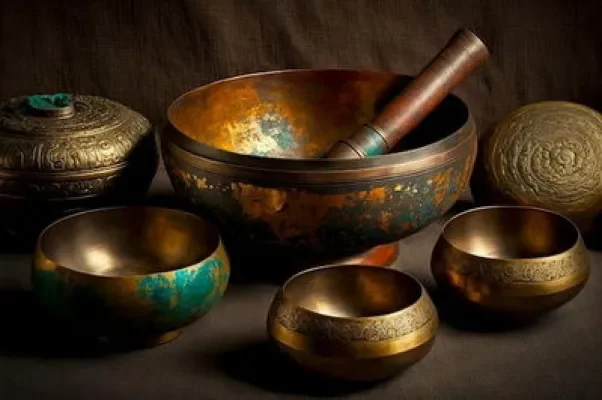
According to surviving historical records, the singing bowl promotes health of body, mind, and spirit. Consequently, many people pick up a metal bowl and begin experimenting with it for health improvement or spiritual development, often teaching each other. Numerous instructions on how to perform rituals appear, frequently mentioning chakras, cosmic energy, and similar popular terms.
Imagine “savages” performing a ritual to communicate with gods using a makeshift (“souvenir”) model of a television — it seems amusing. The analogy with singing bowls is clear. However, we must remember that a real television does exist; the difference lies in the level of craftsmanship. The tools and methods matter. Methods for using singing bowls, if not restored, are being newly developed by health professionals and demonstrate high efficacy.
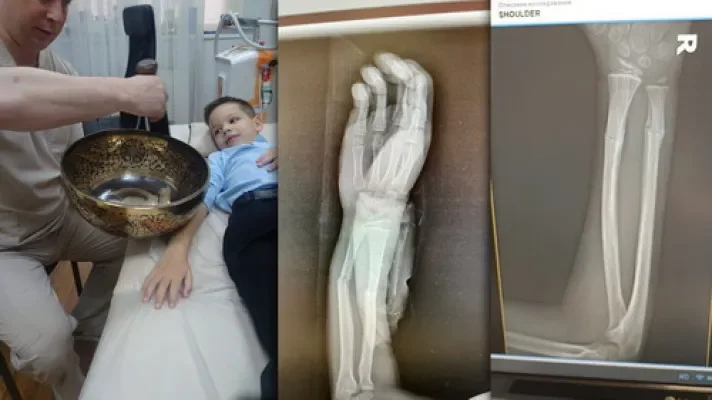
What Benefits Can Singing Bowls Provide?
To speak confidently about this, we must first distinguish between different uses and sources of information. Sources may be esoteric enthusiasts or health professionals with medical training. There are countless esoteric traditions — you can explore them independently and try various rituals. If you are interested in practical applications for health preservation and restoration, seek sources created by relevant specialists — doctors and psychologists. Always keep these two domains separate in your mind when conducting research: esoterics and science. They are not opposites, but they are distinct. Singing bowls themselves are neither one nor the other.
As an example of a reputable scientific source, we recommend exploring the methods developed by Dr. V. P. Surikov.
If you are offered esoteric knowledge, be clear that you will be learning esoterics. You will train imagination and perception, meditate, relax, and exercise your mind. Sound will help you focus on imagined outcomes. You will be participating in rituals and using ritual objects — singing bowls — that are beautiful and accessible to everyone. These are souvenirs — cast or forged singing bowls mass‑produced at low cost and convenient for transport. You can buy them in any esoteric shop or online marketplace. Often decorated with symbols to aid concentration, they allow you to acquire basic skills in producing sound with various tools and to feel connected to an esoteric movement promoting spirituality. Perhaps such concentration may help awaken latent healing abilities — if you have them among your talents. All this is a mental game. It is beneficial if you recognize it as such — a game of the mind and meditation.
Which singing bowl to choose for esoteric meditation? Consider these criteria: affordability, appealing appearance, pleasant sound. If the sound is unpleasant to you but someone claims it is beneficial, this may suit the seller or your guru’s authority — but it does not suit you. Choose a comfortable sound for yourself. Do not listen to countless claims about which frequency will make your chakra, third eye, stomach, or spleen happy. Otherwise, you risk losing touch with reality and may need a special singing bowl to restore that connection — which they will also sell you.
The Popular Trend: “Massage with Singing Bowls”
What is massage? It is a method of prevention and treatment through mechanical manipulation of the body. Massage techniques are taught and practiced by medical professionals (Western, Eastern, Traditional Chinese Medicine, etc.). Therefore, seek knowledge about massage from such professionals. If you learn massage from esoteric practitioners, you will learn esoterics and imitation massage — remember this. If someone teaches you massage and mentions chakras, you are not learning massage — you are learning esoterics, likely of low quality. The reliability of information and efficacy of methods will be questionable. Feel free to ask: “Who are you?” and “On what grounds do you teach a medical discipline?” — this is necessary and proper. The legitimacy of the training process and documentation are also important — verify them. Esoteric practitioners often issue certificates of mastery to each other and teach non‑existent professions — it is quick, cheap, and promises happiness, wealth, success, and a new profession. These are their hallmarks.
How Should We Perceive and Treat Singing Bowls?
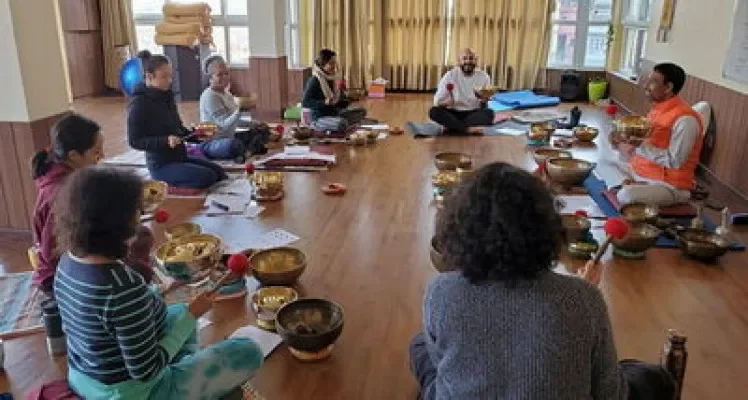
It depends on the source of information. There are sincere dreamers, deceivers, and highly professional specialists. Simply learn to distinguish one from another. For many years, Dr. V. P. Surikov’s methods and Healingbowl® singing bowls have been used in many countries, both in families and professionally in wellness, rehabilitation medicine, and psychotherapy.
How Should We Perceive and Treat Singing Bowls?
It depends on the source of information. There are sincere dreamers, deceivers, and highly professional specialists. Simply learn to distinguish one from another. For many years, Dr. V. P. Surikov’s methods and Healingbowl® singing bowls have been used in many countries, both in families and professionally in wellness, rehabilitation medicine, and psychotherapy.
1. Crystal Singing Bowls
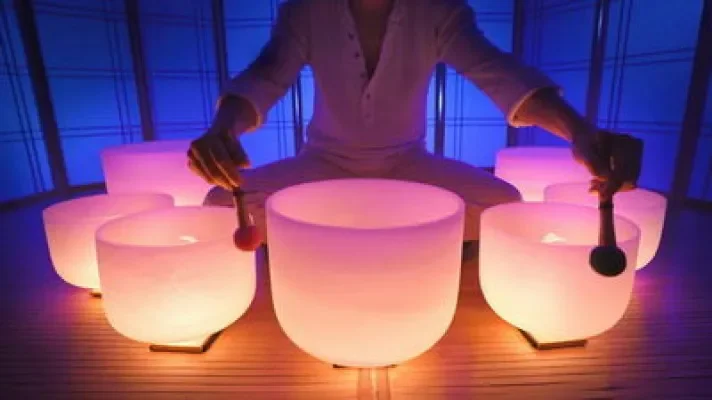
Made from molten quartz sand — a modern invention with a short history of use. They are musical instruments by all measures. Favored by esoteric practitioners, they produce a monotonous, simple sound. The procedure is beautiful and mesmerizing, but vibrational impact is weak. No systematic scientific methodology for practical application exists. They are musical instruments.
2. Cast “Tibetan Bowls”
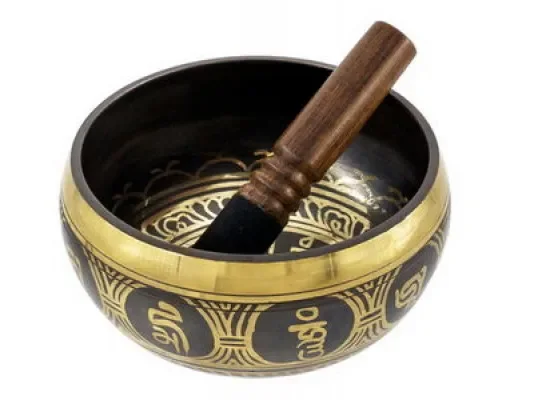
Beautiful, inexpensive, and easy to use. Their sound is monotonous and short due to simple alloy composition and “loose” crystalline structure. Made primarily of copper, somewhat similar to bronze. Highly popular in esoteric circles as ritual objects, they are attributed many miraculous properties — though no scientific evidence supports these claims. Functionally, they are souvenirs: symbolic likenesses that do not work on their own but support the power of imagination or intention. Recall the vajra. Cast singing bowls are ritual objects, souvenirs, imitations of something real — primitive musical instruments.
3. Forged Singing Bowls
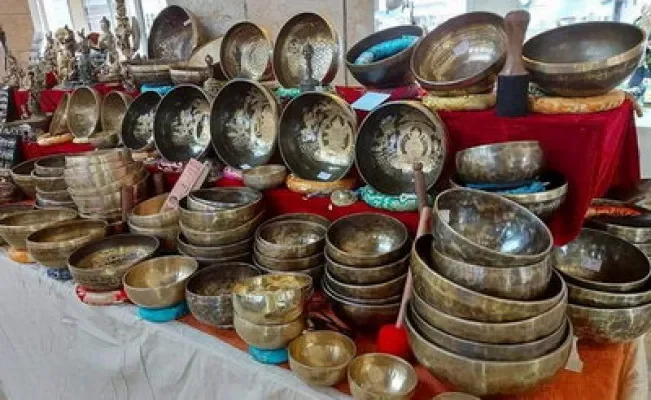
We now approach what truly works and brings benefit. Forged singing bowls are produced in Nepal in large quantities and are also called “Tibetan singing bowls”. Why “Tibetan”? The birthplace of the singing bowl is Nepal. Most images on the bowls derive from Tibetan Buddhism symbols — hence the name. In Tibet itself, singing bowls are largely unknown, not manufactured, and not used. If someone claims “this singing bowl is from Tibet” or “I learned from Tibetan monks”, it is fiction — a lie.
These bowls are made by hand forging from an alloy close to bronze (approx. 80 % copper, approx. 20 % tin). Any elaborate claims about alloy composition are fiction — esoteric marketing. “Seven chakras, seven metals” — detailed stories about the alloy that later fail metal expertise. It is copper and tin, with trace amounts of other metals.
If someone told you otherwise — congratulations, you’ve caught that person in a lie. We conducted an expert analysis of the finest, most magnificent singing bowl after we broke it. We work with the best workshops in Kathmandu. The craftsmen don’t tell us fairy tales, and we don’t tell fairy tales to our customers. We provide our clients with ready‑made instruments under the Healingbowl® brand, all featuring outstanding characteristics. But we’ll get to that later.
You need to understand one key thing: during the process of hand forging, the metal’s crystalline structure acquires new physical properties. These changes are not uniform throughout the metal’s volume. As a result, the sound becomes far more complex and interesting than that of a cast bowl. A forged bowl rings longer, and it produces not just a single tone but many overtones. This is excellent. However, on the other hand, such production requires much greater skill to achieve a uniform, harmonious sound. The changes that occur during forging are very difficult to control. The outcome is largely unpredictable. To achieve high quality, one must work slowly, frequently cooling and heating the bowl, carefully processing it. As a rule, nobody strives to do this. Far from all workshops are capable of producing high‑quality instruments. Moreover, nobody wants to invest maximum effort into crafting each individual bowl — because the buyers are tourists and esoteric enthusiasts who are satisfied as long as the bowl is forged, beautiful, and “magical”. Few people truly understand the nuances well enough for there to be a need to put in extra effort.
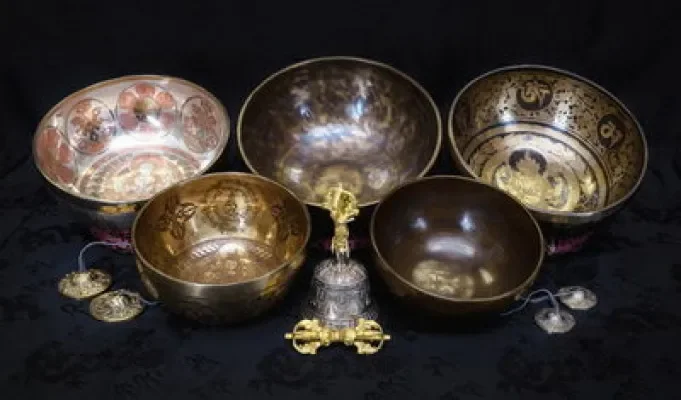
With extensive experience in the practical use of singing bowls, we are able to adequately assess their quality. We confidently assert that most such items are only relatively useful from the standpoint of sound. The “usefulness” is determined by numerous complex parameters. Sometimes even an inexperienced person can easily tell the difference between good and bad sound in a singing bowl. However, in most cases it is difficult to discern without experience, and an unfavourable sonic effect can accumulate imperceptibly, causing mental fatigue.
When it comes to singing bowls for massage — a currently popular practice — it is extremely difficult to find maximally effective and user‑friendly low‑frequency specimens on the market. This is especially true if we want thin‑walled bowls suitable for massage to also sound pleasant and be appropriate for meditation and sound therapy.
The unequivocal conclusion is this: mass artisanal production falls into the category of souvenirs. Absolutely all bowls produced en masse are souvenirs. Among them, one often finds specimens well suited for meditation, and very rarely — ideal for massage. Singing bowls for massage is a topic worthy of separate consideration.
Thus, a mass‑produced forged bowl is a souvenir; many specimens are suitable for meditation and sound therapy. Only extremely rare examples are appropriate for physiotherapy (“massage with singing bowls”). This is precisely why esoteric practitioners love singing bowls so much. The blurred boundaries of quality provide ample grounds to speak of benefits, to discuss energy, chakras, space purification, and so on. Everything is as magical and mysterious as possible, requiring to be taken on faith. To reliably determine the quality of an item, an experienced expert is required.
Consequently, the idea of going to a souvenir shop, buying a “magical” object, completing a two‑day “training”, and becoming a healer (“sound therapist”, etc.) is not entirely reasonable or mature. To begin providing professional services, professionals must be involved at every stage — including in the creation of professional instruments for work.
The images on singing bowls typically have roots in Tibetan Buddhist culture — this is a local tradition. However, it is important to understand that the bowls themselves are not religious cult objects. All our inquiries have shown that Tibetan monasteries do not have practices involving singing bowls. As a rule, Tibetan monks and lamas learned about the properties of singing bowls from us for the first time. Therefore, do not regard the singing bowl as a religious object. The images merely convey a certain mood of Tibetan culture. If you do not understand such images, they have only the most general effect — like any abstract graphic. For example, primitive simple drawings may simply be pleasant and slightly mysterious, conveying the most superficial and basic state. The more refined the artistic image, the more nuanced perception you will develop.
Beauty and high quality of visual imagery have a certain power in themselves. We hope you understand the difference between a simple naive craft and a work of art. Naturally, this affects the price. Moreover, rest assured that if considerable effort has been put into making a singing bowl beautiful, then the quality of the bowl itself is also higher — both in terms of alloy composition and forging technique.
What images appear on singing bowls?
Ornament elements always symbolize the lotus, the movement of the sun, and elements of Kalachakra. Often one sees the endless knot of Dharma teachings, the “eyes of Buddha” (which are actually a Lemurian symbol), or the so‑called “Eight Auspicious Symbols” carrying various blessings (health, success, etc.). It is believed that a singing bowl transmits the meaning and energy of these symbols into space. It would be more accurate to say that it does indeed transmit — but not the drawings themselves, but rather your state, mood, and intention.
Besides ornamental elements, you may see human figures: Bodhisattvas — White or Green Tara, Manjushri, Buddha, Avalokiteshvara, Chenrezig, or other figures of Tibetan culture. Less frequently — Ganesha, Shiva. The “Flower of Life” is also often encountered.
On Healingbowl® singing bowls, high‑artistry images may also be applied — but only on collectible bowls. On professional Healingbowl® singing bowls there are no images except the logo. They are called professional precisely because they are suitable for use by professionals in rehabilitation medicine and spa settings: they possess all necessary qualities, are very convenient to work with, and lack images so as to be suitable for all people.
4. Professional Singing Bowls and Healingbowl® Methodologies
The ancient idea of sound‑based influence has been transformed in modern times into a clear, systematic Healingbowl® methodology. It consists of two key components:
The sound itself, along with its sources.
A system of sequential actions involving these sound sources.
Consider this: are effective intuitive actions with medical equipment possible? No. With singing bowls — only to a certain extent.
Is effective treatment possible using a professional methodology but with makeshift tools of random quality? Also not entirely.
Therefore, what we need are:
professional tools;
a deeply grounded system — one that is clear and easy to replicate.
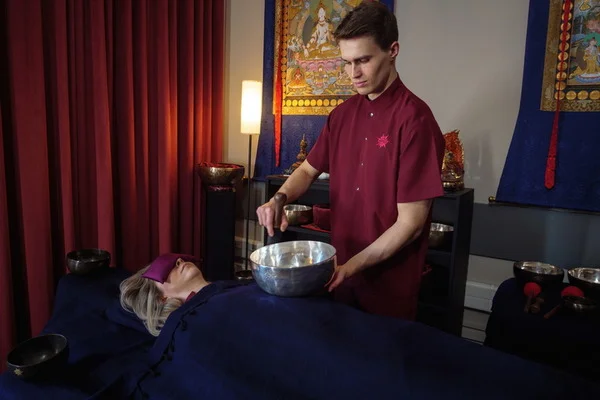
Acoustic methodologies. This category includes such concepts as sound healing, sound bath, and others. First and foremost, a rehabilitation acoustic methodology was developed (authorship registered in 2016). Its author is Dr. V. P. Surikov, an anesthesiologist and intensive care physician who also studied Traditional Chinese Medicine and numerous types of massage. Over many years of practice, requirements for the sound of singing bowls were established. An agreement was reached with the best workshops in Nepal, and production of singing bowls of the required quality under the Healingbowl® brand was organized (the trademark is registered in numerous countries around the world). The methodology can be studied in person under the guidance of Healingbowl® instructors or through video courses. Healingbowl® singing bowls are produced exclusively by order and under the supervision of Healingbowl®, available in specialized stores.
The art of assembling Healingbowl® singing bowl sets is of great importance. A set of singing bowls is a unified instrument, compiled strictly according to a specific scheme and principles developed by Dr. V. P. Surikov. The composition and quality of the sets strictly align with Dr. Surikov’s methodologies. The highest quality and effectiveness of the sets’ sound are guaranteed by the vast experience of Healingbowl® production specialists. To the best of our knowledge, no one has managed to replicate the quality of Healingbowl® singing bowl sets so far, despite numerous attempts.
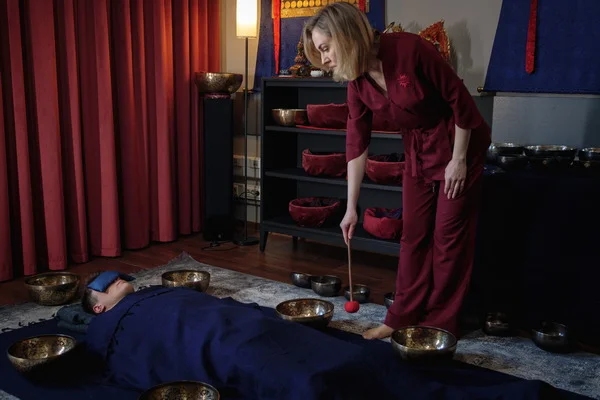
This all pertains to acoustic (remote) methods using singing bowls. The second crucial method is the contact (vibro‑acoustic) approach, including Vibropuncture (acupressure massage) using Healingbowl® singing bowls.