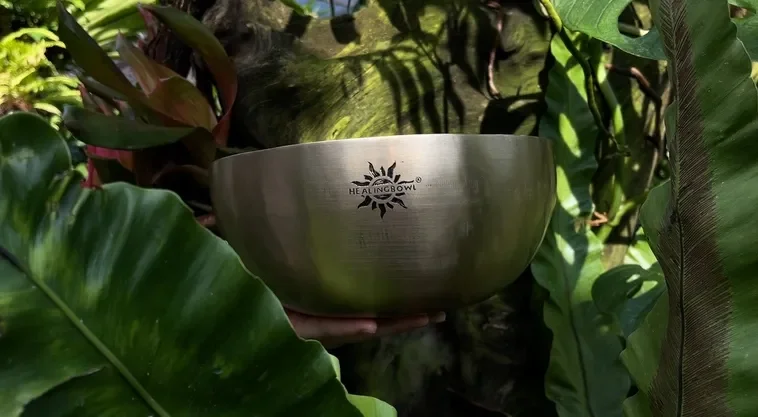
The main advice for a beginner when choosing a singing bowl
Let us offer a straightforward recommendation. If you see yourself as a unified, balanced entity, you’re likely ready to appreciate the value of a singing bowl set — one that reflects the same harmony. The Healingbowl® set functions as a kind of matrix, perfectly tuned to resonate with your inner balance. Its sound will help align you accordingly. Depending on your state or needs, you can focus attention on any individual bowl within the set.
We produce two types of sets. The first is the Small Acoustic Set, comprising seven bowls tuned to an activating frequency range. Each bowl in this set provides a gentle, soothing stimulus toward positivity. When used together, the seven bowls delicately activate the processes within your system, encouraging a subtle yet noticeable shift toward greater vitality.
The second type is the Large Universal Set, also consisting of seven bowls. This set produces calm, deep tones that have a markedly different effect. When played with the correct algorithms — which we teach in our courses — the sound soothes, relaxes, and shifts you into a self‑restoration mode. These sound algorithms were developed by Dr. V. P. Surikov and are available through both in‑person and online instruction, offered in the form of comprehensive courses and personalised consultations.
For those seeking the most comprehensive experience, we offer a Complete Set comprising 14 bowls — a combination of both the Small Acoustic and Large Universal sets. This full collection provides the widest range of therapeutic and meditative possibilities, allowing you to tailor your practice to your evolving needs and create a truly personalised sound journey.
One bowl is additionally purchased if it is a special massage bowl with a pronounced vibrational effect for contact massage and self‑massage, or a «giant» bowl.
Also, a single bowl can be a useful and valuable gift.
We have analysed and identified a set of parameters that lead to a positive effect. It is quite difficult to select such specimens in mass production. Therefore, since 2018, we have begun to commission the production of bowls with deliberately the best characteristics. We call them professional. Much more work is invested in them, and some additional technological secrets are applied. This increases the cost but provides a guarantee of quality.
For a beginner, most bowls sound normal and interesting, but when trying to compare and choose, fatigue sets in quickly. You have probably encountered this effect. Also, possible dissonance in the sound of bowls in your collection is quite expected if the selection is not systematic.
We completely eliminate the risks and difficulties described above. Our bowls sound harmonious and only carry different emotional tones, depending on the pitch. This is especially true for Healingbowl® singing bowls of our production. We create our own design.
We call Healingbowl® bowls «professional» because they provide the best effect in professional use. They are ideal for beginners, as they are more «obedient» and forgive many mistakes.
What a beginner needs to know about singing bowls
You probably know that the sound of forged singing bowls calms and helps you immerse yourself in your inner world, experience great pleasure, and relax. You may have heard that spaces where singing bowls are played become more harmonious. However, you may not know anything about the vibrational capabilities of singing bowls. Sound is vibration. The effect of singing bowls is greatly enhanced when we place a professionally crafted forged singing bowl on the body and induce vibration.
Over many years, we have taught hundreds of people around the world to use this property of singing bowls. Healingbowl® singing bowls are used in professional practice by massage therapists, psychotherapists, spa specialists, reflexotherapists, neurologists, and even intensive care physicians. However, our methodologies are very easy for anyone to master, even without special education.
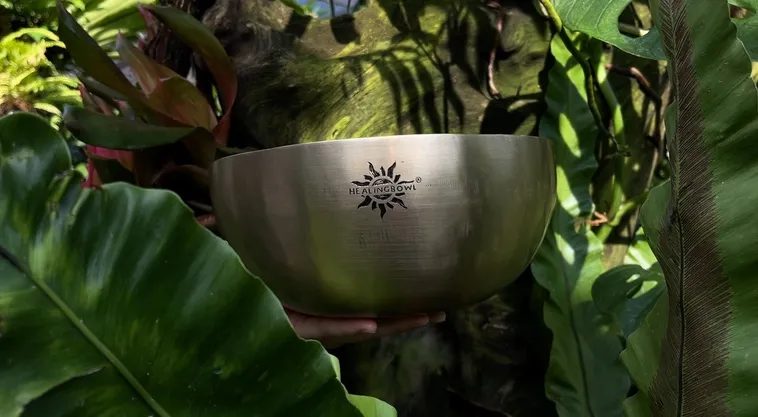
With the help of high‑quality low‑frequency Healingbowl® singing bowls and our methodologies, you can: relieve nerve compression, improve blood properties, eliminate general tension and muscle tension in any part of the body, reduce pain, enhance metabolic processes, speed up recovery after injury, prevent many diseases or significantly accelerate treatment, achieve a strong detox effect, rejuvenate facial skin, and much more.
Of course, not all singing bowls are suitable for these purposes, and we will help you understand their differences.
The Difference Between Cast and Forged Singing Bowls
Each cast singing bowl produces a single tone (at most, two). In contrast, when you listen to a forged singing bowl, you hear several «voices» at once. These include the fundamental tone (the lowest one) and several higher tones (overtones). All of them pulsate and shift in sound. From this perspective, forged singing bowls are more appealing.
The structure of the metal’s crystal lattice changes during the hand‑forging process, developing characteristic tensions. This is precisely why the sound of a forged singing bowl is more complex and captivating.
The advantage of cast singing bowls lies in their lower cost. They can also be quite beautiful. Cast bowls easily begin to «sing» when you move a stick in a circular motion along the rim of the bowl. This effect surprises and mesmerises. For these reasons, they make a good, affordable gift.
For a beginner, cast bowls bring a great deal of joy — especially if they are of high quality, such as those from the well‑known Healingbowl® brand, which also produces cast bowls for the mass market.
Over time, interest often grows toward something more substantial — namely, forged bowls and singing bowl sets.
Small and Large Singing Bowls
All singing bowls produce sounds within the human vocal range. If you compare different singing bowls with walls of the same thickness, you’ll make an important first observation: the larger the diameter, the lower the tone.
Small bowls produce high‑pitched, «childlike» voices. This kind of sound grabs attention, helps you distract from daily worries, and gives a boost of positive emotions. At the same time, you remain calm because their sound is harmonious — and that’s valuable.
If you have several singing bowls, you can immerse yourself in musical creativity that doesn’t require any special knowledge or skills. Your listeners will also appreciate it. This is useful in tea ceremonies, sound therapy, psychotherapy, yoga, and meditation — whenever you need to keep the mind sufficiently clear.
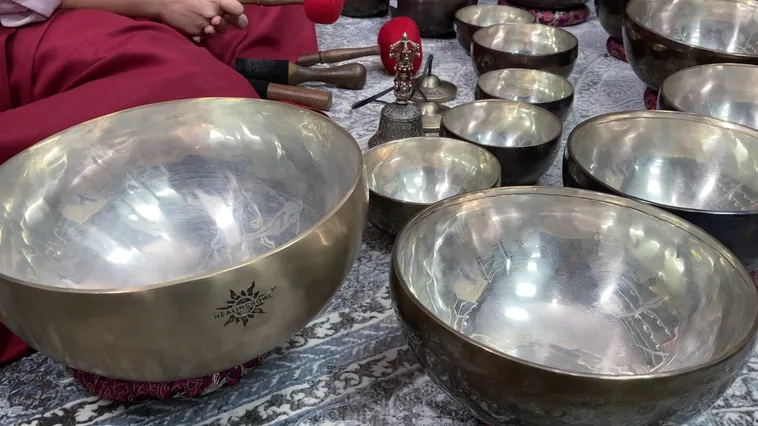
Remember this rule: the lower the tone, the more calming its effect. Larger‑diameter bowls produce lower sound frequencies. The pitch descends from a «childlike» tone to a «female» voice and then to a calm «male» voice.
At a certain point, a large singing bowl’s sound begins to induce a mild trance state. This corresponds to deep meditation or light, superficial sleep. In such a state, a person rests and recovers much faster and more effectively than during ordinary sleep.
It’s impossible to specify exactly which frequency is considered calming — the change is gradual. It depends on your individual perception and initial state. You can easily find out which bowl suits you, even if you have no prior knowledge. Simply listen and observe how your state changes. Trust your subjective assessment.
Besides diameter, wall thickness also influences the pitch. If you compare two bowls of the same diameter but with different wall thicknesses, the bowl with the thicker wall will produce a higher‑frequency sound. Additionally, a thick‑walled bowl typically has a longer‑lasting and more powerful resonance.
The Sound Frequency of a Forged Singing Bowl
This important parameter will be discussed in detail below. It is essential to understand the following: a singing bowl produces sound across multiple frequencies simultaneously, and the acoustic field it creates is dynamic and active. For this reason, a singing bowl is not suitable as a conventional musical instrument, and it is never possible to speak of precise frequency values.
The lowest frequency in the bowl’s sound range is considered the fundamental (or primary) frequency, as it has the most noticeable effect on the human psyche and body. This frequency is what is typically referred to as the «bowl’s frequency». In addition to the fundamental tone, we also hear numerous overtones (higher tones). These can be very close to the fundamental or quite high in pitch. This is what determines the multifaceted nature of the singing bowl’s acoustic impact.
By using different tools, we can produce very different sounds — especially with larger bowls (20 cm in diameter or more).
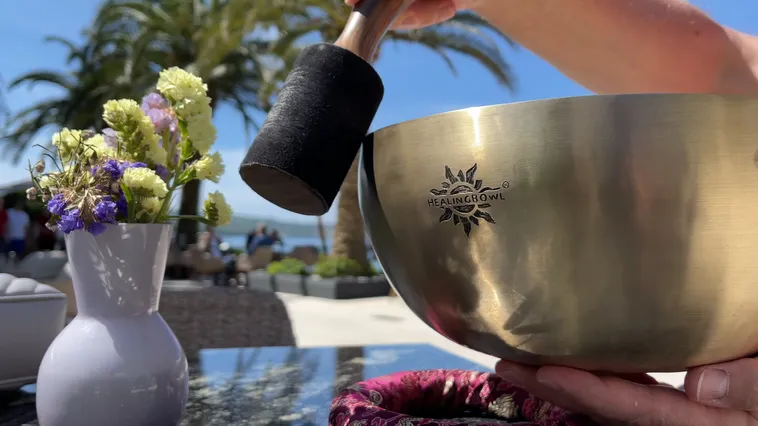
A mallet (also called a gong stick or beater) is used to produce the lowest, deepest sound the bowl can generate. The softer and heavier the mallet, the more clearly the low tones will stand out.
Every bowl has its limits — a specific sound range. For example:
a 28 cm‑diameter bowl with a fundamental tone of E (80 Hz) may produce an overtone of C at 550 Hz, among others. This is a very wide range, filled with additional overtones;
a bowl tuned to C (134 Hz) may have a G overtone at 770 Hz.
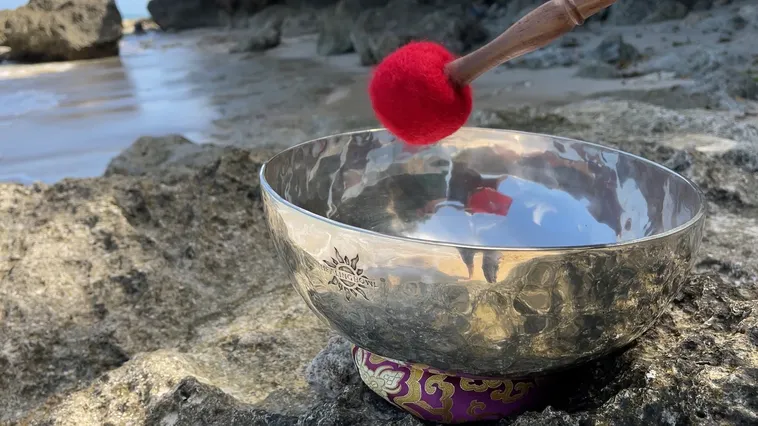
High tones become prominent when a hard stick comes into contact with the rim of the bowl. The lighter and harder the stick, the more pronounced the high overtones will be.
Sequentially touching the bowl with a hard stick and then striking it with a soft mallet will activate the full range of frequencies.
The «richness» of the sound and the beneficial nature of its acoustic impact depend on:
how evenly the sound range is filled with overtones;
how harmoniously the overtones blend together.
The Vibration of a Singing Bowl
Of course, all singing bowls vibrate — after all, sound is vibration. If you can hear it, the bowl is vibrating. However, lower‑frequency vibration is more valuable in terms of its impact on liquids and the human body.
If you want to structure water, we recommend choosing a bowl with a diameter of at least 20 cm and a medium or thin wall. The larger the diameter (and thus the lower the frequency), the more beneficial the effect on water structure. We discuss this phenomenon in detail in a separate article.
If you intend to use the bowl for massage, you need one with a fundamental frequency no higher than 180 Hz. At 160–180 Hz, the effect on the body will be shallow and localised, yet still noticeable. The lower the frequency, the deeper, broader, and more beneficial the impact on the body.
At 150 Hz or lower, the bowl is considered to have average performance and is classified as universal — suitable for acoustic, massage, and vibration applications.
At 120 Hz or lower, a singing bowl can become a full‑fledged physiotherapy tool — provided it is of high manufacturing quality.
Please pay attention to the professional line of Healingbowl® singing bowls. These are specifically designed to:
deliver a reliably beneficial effect;
ensure comfortable control over both sound and vibration.
Such bowls are easy for beginners to handle, even without prior experience.
Quality of Manufacture
With cast singing bowls, the situation is straightforward: quality primarily depends on the alloy composition. Copper is always the main component. As a rule, an alloy closer to bronze produces a brighter sound than brass, because it is harder.
With forged singing bowls, things are more complex. The forging technique is crucial. The more labour invested, the better the result. Some bowls are quickly and simply shaped into the required form. Others undergo many cycles of forging (heating – forging – cooling), and additional secrets are applied to further enhance quality. The duration of processing affects sound quality more significantly than the complexity of the alloy composition.
Do not place too much emphasis on what sellers say about alloy composition:
first, the composition is usually kept secret;
second, the forging technique is ultimately what matters most.
Moreover, other factors also influence the final result — sound and vibration quality:
proper wall thickness distribution;
edge finishing quality;
bowl shape.
There is essentially no basis to expect high quality across all parameters from souvenir‑grade products (and mass production in Nepal and India is, in fact, souvenir‑oriented). Although some reasonably good specimens do exist.
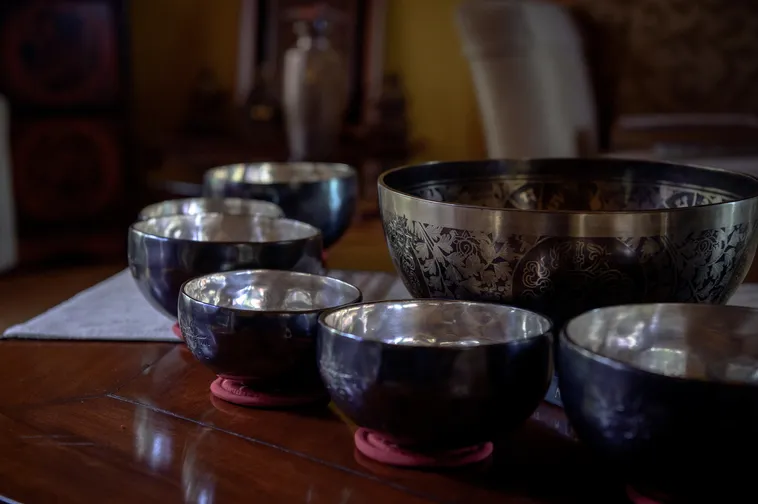
The Healingbowl® logo on a bowl is the only real guarantee of quality. Such bowls are made to order, and extensive attention is devoted to quality control across all parameters.
Key Indicators of High Quality
More overtones are better. Sound richness and range saturation make the experience of immersing in sound more valuable.
Harmonious interaction of overtones is better. The more cohesive the overtones, the finer the sound.
Longer sustain is better.
For a bowl to be suitable for massage, it must:
easily begin to vibrate when a hard stick slides along its rim;
allow smooth sliding (without jerks, slips, or extraneous noises);
maintain vibration steadily at the lowest frequency (the bowl’s fundamental tone).
If you hear rattling, or if the bowl starts to «sing» (produce a high‑frequency sound), two possibilities exist:
You may simply lack the necessary skill. In this case, our video lessons can help.
You may have an unsuitable specimen for massage purposes. Perhaps this bowl is intended only to please you with its sound.
How to Make the Right Choice
If you consult Healingbowl® advisors on selecting a singing bowl (or a set of singing bowls), you are guaranteed that your choice will match your needs and capabilities.
Our online video tests are also helpful when choosing a bowl in our webstore. These videos demonstrate:
the sound of high overtones;
the fundamental tone;
the ability to sustain low‑frequency vibration when a hard stick slides along the rim;
the capacity to produce a high sound («singing») with different sliding techniques (rubbing, rotating) using a hard stick.
We always select specimens for our stores that are unlikely to disappoint in terms of quality.
Healingbowl® Singing Bowls
Healingbowl® is a registered trademark protected against counterfeiting in numerous countries. Our company has invested considerable effort to ensure the production of singing bowls using the most sophisticated techniques to achieve the highest quality.
The master craftsmen’s secrets are never applied to mass‑produce popular types of singing bowls. However, if you see the Healingbowl® logo on a singing bowl, it is a guarantee of:
high quality;
application of advanced manufacturing techniques;
strict quality control at every stage.
The logo is a reliable indicator of excellence. All you need to do is choose the design, purpose, and size that suit your needs.
Healingbowl® offers several lines of professional and collector’s singing bowls. These lines differ in:
design (aesthetic features, finishes, decorative elements);
intended use (acoustic performance, massage applications, therapeutic purposes, or collectible value).
Each line reflects our commitment to:
preserving traditional craftsmanship while integrating modern quality standards;
ensuring consistent acoustic performance and vibrational properties;
delivering products that meet both professional and personal needs.
Artistic Decoration
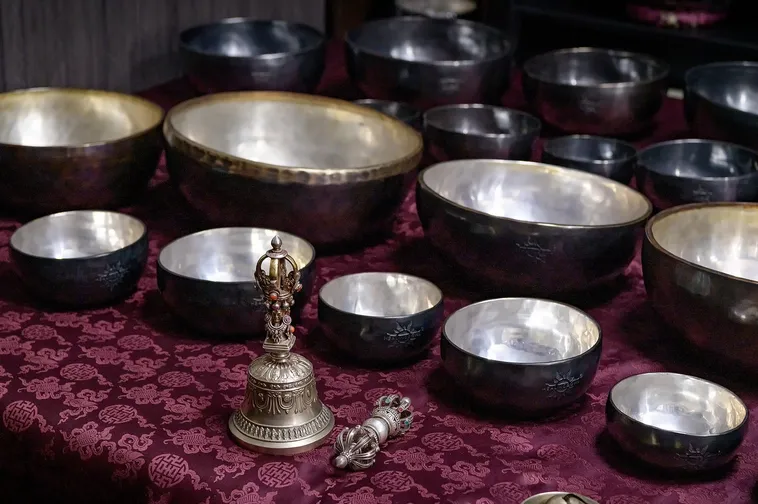
The images adorning a singing bowl typically draw their roots from Tibetan Buddhist culture — this is a local tradition. However, it is important to understand that these bowls are not religious cult objects.
Our research has consistently shown that Tibetan monasteries do not have practices involving singing bowls. In fact, many Tibetan monks and lamas first learned about the properties and uses of singing bowls from us. Therefore, please do not regard a singing bowl as a religious item.
The imagery serves primarily to convey a certain atmosphere and mood associated with Tibetan culture. If you are unfamiliar with the symbolic meaning of these designs, they will have only a general effect — much like abstract graphics.
Simple, primitive designs may appear merely pleasant and slightly mysterious. They tend to evoke a superficial, straightforward emotional state.
More intricate and refined artwork fosters a subtler, more nuanced perception. As you engage with such imagery, your sensitivity and depth of experience may gradually deepen.
In essence, the decoration enhances the aesthetic and atmospheric dimension of the bowl, but does not confer any inherent ritual or doctrinal significance.
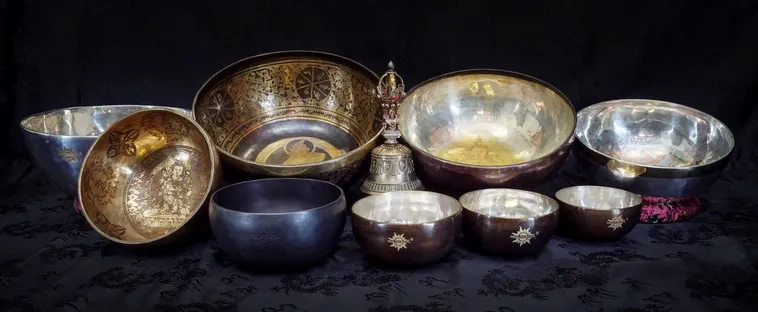
The beauty and high quality of visual images possess a certain power in themselves. We hope that you understand the difference between a simple naive handicraft and a work of art. Naturally, this affects the cost. Moreover, be sure that if a lot of work has been put into making a singing bowl beautiful, then the quality of the singing bowl itself is higher — both in terms of the alloy composition and forging technique.
What is depicted on singing bowls? Ornamental elements always symbolize the lotus, the movement of the sun, and elements of the Kalachakra. We often see the endless knot of the Dharma teaching, the «eyes of the Buddha» (in fact, this is a Lemurian symbol), or the so‑called «eight auspicious symbols», which convey various kinds of well‑wishes (health, success, etc.). It is believed that a singing bowl transmits the meaning and energy of these symbols into space. It would be more accurate to say that it indeed (!) transmits, but not the drawings themselves, but your state, mood, and intention. Besides ornamental elements, you may see human figures. These are Bodhisattvas — White or Green Tara, Manjushri, Buddha, Avalokiteshvara, Chenrezig, or other figures of Tibetan culture. Less commonly — Ganesha, Shiva. The «Flower of Life» is often found.
On Healingbowl® singing bowls, highly artistic images may also be applied if these are collector’s singing bowls. On professional Healingbowl® singing bowls, there are no images except the logo. They are called «professional» because they are suitable for use by professionals in restorative medicine and spa treatments, as they possess all the necessary qualities, are very convenient to use, and have no images so as to be suitable for all people.
Accessories for Singing Bowls and Application Techniques
We have already mentioned the two main accessories: the stick and the mallet (gong stick, or «beater»). The stick should be made of hardwood to be heavy, and covered with thick suede to avoid sharp sounds upon contact and to easily produce low‑frequency vibration during rotation. The most challenging technique is precisely the rotation. As you master it, you develop fine motor skills and overall sensitivity. If the bowl is capable of both vibration at the fundamental frequency (using the rotational technique) and high‑frequency sound («singing»), then all you need to do is master the nuances of the technique.
To produce a «massage‑like» low‑frequency vibration, you must hold the stick correctly (refer to our video lessons or attend in‑person training), lightly touch the edge of the bowl’s wall, and begin a fairly rapid (!) sliding motion along the rim. At this point, the stick should be positioned closer to a vertical orientation. You should hold the stick by its suede portion, near the contact zone with the bowl — like a thick pencil, «drawing» the bowl’s circumference. During this rapid movement, the pressure should be minimal and your wrist should remain relaxed. Vibration should appear very quickly. Before it turns into a rattle (you will learn to sense this moment), you must halve the speed of your movement and slightly increase the pressure. Then, maintain the vibration by continuing the rotation. Do not try to achieve maximum vibration intensity — about 70 % of the possible intensity will suffice. If you make the angle of the stick’s inclination greater, it will contribute to damping the vibration. When choosing a stick, opt for a sufficiently massive one, with good inertia.
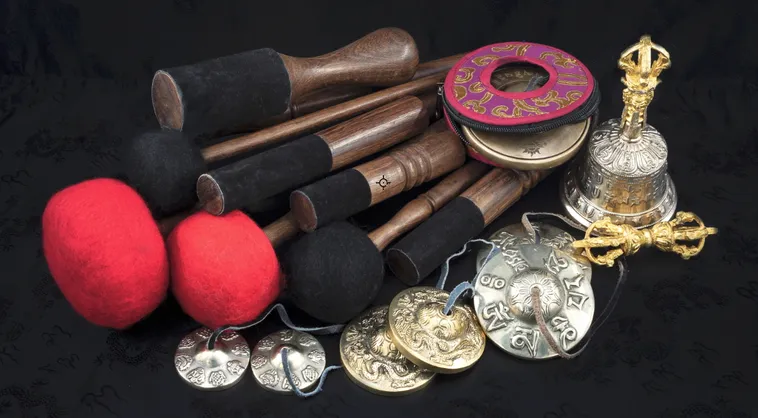
To produce «singing», you need to change your movement. Let the angle of inclination be about 45 degrees from the start, and make the movement slow and viscous. Create friction between the suede and the rim of the bowl, pressing fairly firmly with the stick. You can first touch the rim of the bowl with the stick to produce a high sound — just not too loudly. Perhaps a slightly lighter stick with not very thick suede, meaning a fairly rigid one, would be suitable for this.
The mallet, as mentioned above, is needed to engage the lower part of the sound range. You should throw the weight at the end of the mallet against the rim of the bowl, right at the edge, so that after bouncing off it continues moving in the direction you initiated the «throw». Your wrist should be relaxed. The heavier and softer the weight, the lower and deeper the sound you will get. For a more «rich» sound, a mallet with a firmer weight of smaller diameter would be suitable. Our consultants can help you with your choice. Be prepared for the fact that it is advisable to have several different sticks and mallets. In this case, one bowl will provide you with a greater variety of sounds, which is more interesting. In particular, there are lightweight mallets with extended handles — these are convenient for acoustic massage sessions when the bowls are placed around the body.
Sets of Singing Bowls: Harmonious Resonance
Any sound, when interacting with another sound, demonstrates the phenomenon of resonance. Even the overtones of a single bowl interact with one another, creating a dynamic acoustic hologram. If its pattern is harmonious, then the effect is beneficial. These are precisely the kinds of bowls we select for our stores.
Moreover, the sound of two or more singing bowls produces strong resonance phenomena in the acoustic space. It is important to choose bowls for harmonious resonance correctly. If you bring a beautiful bowl into your home, and then another beautiful bowl, you may be in for a surprise. Together, they do not always produce a harmonious sound. Two or more bowls may either complement each other harmoniously or transmit conflict and dissonance.
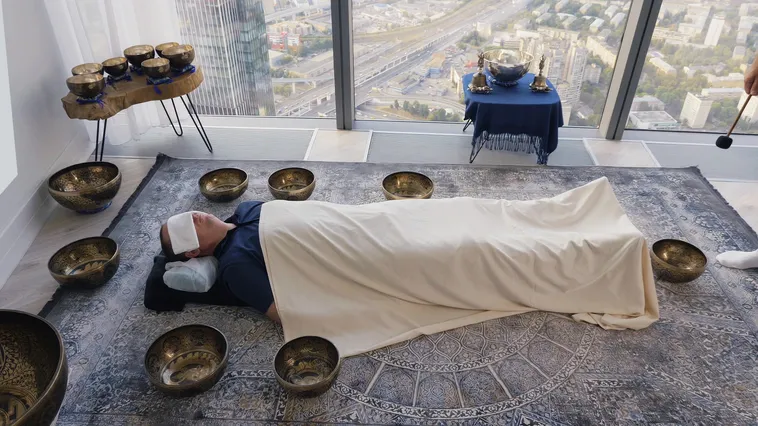
There are rules of musical mathematics that allow us, knowing the fundamental frequency of a bowl’s sound, to match it with another bowl in good harmony.
If you know the frequency of your bowl’s sound, we will match it with a harmonious counterpart. It is important to be able to determine the frequency correctly. You may be surprised, but nowadays not all manufacturers and traders in Nepal do this correctly! And just five years ago, almost no one could do it at all.
Perhaps Nepalese craftsmen can now assemble good sets — but we have never seen such. We are confident they cannot. After all, this requires intelligence and experience, which the specialists at our Healingbowl® company possess.
It should be noted that Healingbowl® sets are always created with the most possible harmonious resonance.
The Correspondence of Notes to Chakras
With sufficient sensitivity, one can notice that certain notes trigger reactions in specific areas of the body, as well as various subtle sensations that may be interpreted as effects of energy movement: intensification of flow, focusing, or dispersion.
Some sources claim there is an exact correspondence between notes and chakras. However, the first and most important step is to define the system in use.
Our practices are based on the perfect fifth (quint). This is because all Eastern healing systems that employed music for therapeutic purposes relied on the fifth. Pythagoras — known for his concept of the «music of the spheres» and the healing of the soul — also used the fifth. Furthermore, our studies, conducted with state‑of‑the‑art scientific equipment, have demonstrated that the fifth offers a 30 % advantage over the octave in the context of singing bowl sounds.
Vedic systems that describe the correspondence between notes and chakras propose the following sequence based on the fifth:
1: F (F#), 2: C (C#), 3: G (G#), 4: D (D#), 5: A (A#), 6: E, 7: B.
At the beginning of our research in 2013, when skilled Nepalese masters — true bearers of the tradition — could still be found, they also adhered to the sequence of the fifth. Later, however, traders adapted to contemporary Western systems and began offering octave sequences, largely to avoid debates with esoteric tourists.
If you are accustomed to the octave system and it works effectively for you, that is perfectly fine. You can select singing bowls from us based on the octave sequence: C, D, E, F, G, A, B (including sharps).
For general understanding, here is the traditional correspondence in ancient healing practices:
Note F corresponds to the first chakra. Element: Earth. Themes: acceptance, safety, comfort, foundation. Related to: skeletal bones, muscles.
Note C corresponds to the second chakra. Element: Water. Themes: fluidity, fertility. Related to: reproductive organs.
Note G corresponds to the third chakra. Element: Fire. Themes: will, confidence, strength. Related to: stomach, digestive system.
Note D corresponds to the fourth chakra. Element: Air. Themes: feelings. Related to: heart.
Note A corresponds to the fifth chakra. Element: Ether. Themes: the plane of events, karma. Related to: thyroid gland.
Note E corresponds to the sixth chakra. Themes: intuition. Related to: pineal gland.
Note B corresponds to the seventh chakra. Theme: connection with the higher plane. Not related to the physical body.
Please note that the same note can sound dramatically different across various octaves. For example:
D in the second («great») octave sounds extremely low and deep (74 Hz);
D in the third («small») octave matches the pitch of a typical female voice (147 Hz);
D in the fourth («first») octave is relatively high (293 Hz), similar to an adolescent’s voice.

When Is This Relevance? This matters partly in cases when you are selecting your first singing bowl and have a specific idea of choosing a bowl for a particular chakra. Okay — you can certainly have that experience. However, it would be better if you simply chose a sound that gives you a state of comfort.
If the bowl matches your initial idea but fails to provide a sense of comfort, it will be a waste of money. Please test this for yourself.
Important! If you intend to perform massage, the tonality of the bowl has no significance whatsoever. In contact‑based techniques, the only relevant factor is that a lower frequency is more effective — and that is all. The fewer hertz, the better — because this is a matter of physics.
Singing Bowl for Massage
In the ideal case, this is a bowl specially designed and crafted for use in contact techniques. Such a bowl should have even walls — sufficiently rigid and elastic — to produce an intense and uniform vibration. The frequency of oscillations is considered sufficiently effective from 170 Hz and below. Naturally, the diameter will be at least 22–23 cm.
At the same time, 170 Hz produces a very localized effect, while as the frequency decreases, the effect becomes broader and deeper. This is due to the physical wave properties of the vibrations. The lowest frequency we encounter in massage bowls is approximately 75 Hz.
There is no need to start a «the lower, the better» race. At different times, for different people, and for different areas of the body, bowls with frequencies not as low as 120–145 Hz are also needed. However, a low‑frequency bowl should definitely be present as the primary one.
A common misconception is that bowls of different frequencies are needed to work with different organs. This is merely a fantasy of some authors, unsupported by an understanding of physiological processes. The knowledge of the pattern described in the previous paragraph is sufficient. There is no need to tie the choice of a «massage» bowl to chakra correspondences. In contact massage, we work with the physical body. Even when placing a bowl on the head, we do not think about the seventh chakra, but rather expect a lymphatic drainage effect, restoration of blood system properties, release of tension, etc. — all of which relate to the physical body.
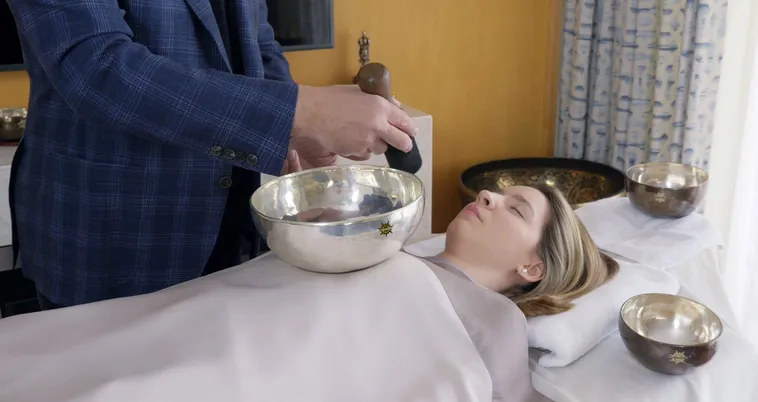
Besides frequency, the quality of the rim’s edge finishing, its shape, and everything that ensures easy vibration onset using a specific technique with a hard stick (covered in suede) sliding along the rim are of utmost importance. We should obtain the most uniform vibration possible — without fluctuations or overtones — at the fundamental frequency of the singing bowl. We call this parameter «controllability». Controlling the vibration should be easy and comfortable, not requiring great skill. When this is achieved, it feels as if «the bowl vibrates on its own».
All these qualities are found in Healingbowl® bowls from the professional lines: Silver Pearl, Golden Pearl, and Surya Pearl. These bowls are specifically created for professional use and cannot be found in souvenir shops. You may come across a thin‑walled, inexpensive bowl with good vibration — technologically, this is not very difficult to achieve. However, it will not sound properly, as it is manufactured using simplified techniques. Healingbowl® bowls, in addition to their «massage» properties, always have a distinct, comfortable sound with a special character — and this is an important component.
Singing Bowl for Meditation
People often ask which singing bowl is suitable for meditation. The answer is quite simple. Remove the requirements imposed on a bowl for massage purposes — and you will have a bowl for meditation.
A comfortable, sustained, harmonious sound will facilitate deep immersion. Avoid the idea that you need to target a specific chakra. Such notions are arbitrary, and many of them are mistaken. Comfort, however, remains comfort — always.
There is one subtle point you might overlook. Meditation is about focus. You are holding an object in your hands. It produces sound. Recall everything we have said about frequencies and quality — the sound aspect will then become clear.
Do not feel compelled to seek out an external specialist who «knows what you need». We are not suggesting that you reject such help outright, but rather that you place more trust in yourself. It is not difficult to distinguish the warm feelings, comfort, relaxation, and a certain affinity or attraction that a bowl’s sound may evoke in you — what we might call a «positive resonance».
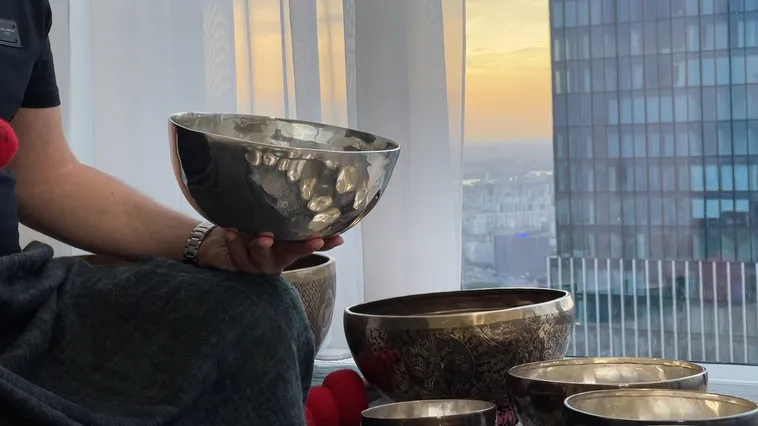
Beyond sound, there are tactile and visual experiences. These effects may not be as immediately noticeable, but they are still significant. Consider the difference between a mass‑market item and a work of art — they are perceived quite differently.
«Sweet and simple» — this sets one mood.
«Simplified symbolic» — this evokes another.
«Laconic and noble» — yet another.
«Delicately artistic» — a different state altogether.
These are all distinct states that will resonate in your life once you align yourself with them.
A collectible singing bowl is a work of art — both in appearance and in its vibrations. Focusing on a rare work of art, one into which the craftsman has poured much labour and inspiration, is a special form of meditation in itself.
Treatment with a Singing Bowl
To actually provide treatment, you must have a clear understanding of the patient’s condition, make an accurate diagnosis, and prescribe appropriate therapy. It goes without saying that this requires you to be a qualified physician — with proper education and relevant clinical experience.
If you are not a licensed medical professional, you cannot provide treatment — whether using singing bowls or any other method.
However, if you are a trained healthcare provider with the necessary expertise, and wish to integrate singing bowls into your clinical practice, this is entirely appropriate. In such cases, you will need:
professional Healingbowl® singing bowls;
thorough knowledge of Healingbowl® techniques, both contact and remote.
When used as an adjunct to conventional treatment, these methods can significantly shorten the recovery period. When applied correctly, professional singing bowls help:
normalize metabolic processes;
improve cellular microcirculation;
eliminate muscle hypertonicity;
relieve psychoemotional stress;
enhance the properties of bodily fluids;
stimulate the body’s overall restorative processes.
These beneficial effects are observed provided there are no contraindications — which you, as a healthcare professional, must be fully aware of.
We encourage you to undergo training in Healingbowl® methods, available both in person and online.
Pay special attention to the unique «Vibropuncture» technique, developed by V. P. Surikov — the owner of the Healingbowl® brand.