关于这件器具
You will get access to a student’s personal account to watch the video course. Access is unlimited in terms of time. You learn independently.
The instruction manual is provided in electronic format.
The author of the methodologies is Dr. Viktor Petrovich Surikov.
Duration: about 5,5 hours. Language: EN or RU (your choice).
A certificate will be issued with the wording “received materials for study”. In electronic format. You can print it yourself.
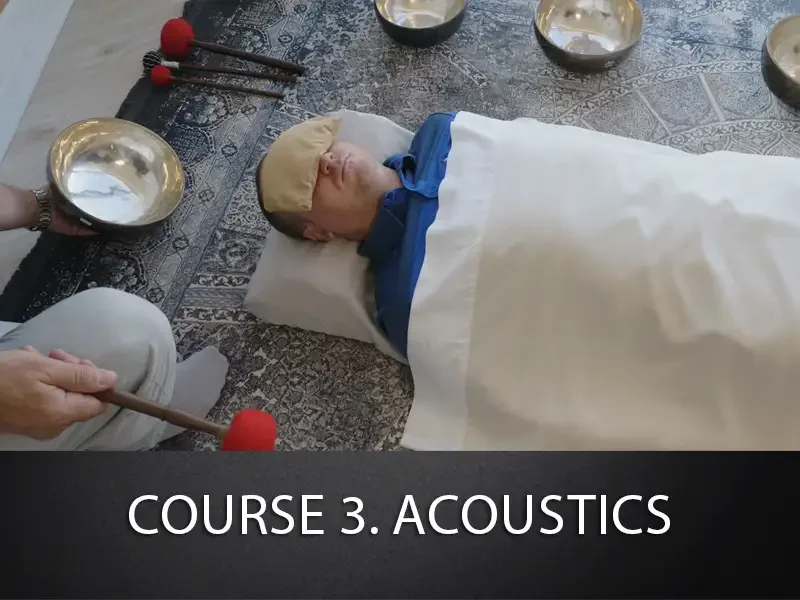
The schemes in this course enable you to learn how to conduct individual and group acoustic programs, including sound meditations. This course is especially important for those who conduct individual sessions and meditations and work with groups of people.
Sound schemes are excellent for practice with children, within the family circle, as home concert‑meditations, in yoga studios, in spa and wellness hotels, etc. Acoustic programs with singing bowls are an eco‑friendly, luxurious way to relieve severe fatigue and stress loads — provided that high‑quality sets and accessories are used in practice.
The Course 3 schemes can even be applied in the office, for self‑use, during breaks between intense meetings and negotiations, helping to restore your psychophysical state and replenish your energy for new achievements.
In our practice, we have experience of major businessmen using Course 3 schemes with top‑tier quality sets during breaks between important negotiations for their business partners.
Absolutely everyone, from all social strata, enjoys the sound and visual effect of harmonious sets — especially those of collector’s quality. The ability to play such sets correctly and to control the sound of the bowls and the listeners’ state is a useful skill in life.
CONTENTS:
Module 1. What is needed to apply the methodology.
Many people have a very superficial understanding of the methodology taught here. Usually, you see a few bowls placed around a person or in front of a group, and you assume that it will be beneficial for everyone to hear you express yourself creatively with the bowls you have. This module provides information on the indications and contraindications (!) for sessions with singing bowls (acoustic method), as well as on which bowls are truly necessary for the effective application of our methodology. The correct set of accessories is also important.
Module 2. Preparing the specialist and the client for the session.
Every person who requests a session is in their own unique initial state, with their own specific problems, ideas, and fantasies. It is absolutely wrong to do the same thing for everyone without any preparation, assessment, planning, or agreement. Here, you will learn how to correct this mistake. You will also become familiar with the rules for preparing yourself for a session (something you may not have considered or may not have given much importance to).
Module 3. Strategy for designing a session and a course of sessions, with the possibility of combining different methods.
One of the most important aspects of knowledge in the field of methodologies that use the sound of singing bowls — alongside the principles of hypnotherapy, music therapy, etc. — is understanding the reasons for choosing the fifth interval (the quint) as a scale and its specific features. Next, you will be invited to broaden your focus to understand the importance of various methods (contact and acoustic) and the possibility of combining them when designing a course of sessions. You will also come to understand the importance of creating course programs in general.
Module 4. Testing and preparing the client for the start of the session.
Different people react to different sounds in different ways at different points in their lives (!). Testing the client’s state and reactions is equally important both as a diagnostic procedure and as a crucial preparatory part of your work with the client. You will learn how to conduct such testing. This will help you view your work with a person as a single, large, and important narrative and will help you understand the importance of conducting a course of sessions rather than a single fleeting meeting that no one considers particularly significant. Next comes a very effective step: the use of the giant bowl. Finally, something that many people unjustifiably neglect is using your voice to adjust the client’s state.
Module 5. Individual session. Acoustic scheme “Zigzag”.
Conducting a session is not just about “placing the bowls around the person and starting to strike them with inspiration”. You have already studied all the preparation stages. Even after completing them, the person is still not ready to productively receive your sound. Here, you will learn how to make the placement of the bowls in the “Zigzag” scheme a separate, important procedure that finally prepares the person for the beneficial effects of the singing bowls’ sound. Then, you will study this scheme in full detail, along with the many nuances of the technique that apply to all schemes.
Module 6. Individual session. Acoustic schemes “Semicircle” and “Sound Code”.
Once the client is fully prepared (you have learned everything about their state and request, planned the work, started the session, completed all preliminary actions, and carried out the first acoustic scheme), you continue working to restore all the body’s systems. The “Semicircle” scheme sets the foundation for harmonious functioning. The “Sound Code” scheme ensures the sequential tuning of the body’s various systems.
Module 7. Individual session. Dissociative scheme and balancing the energy system.
All the previous steps have brought your client to a deep state of relaxation, akin to light sleep. In this state of total trust in what is happening, restorative processes are activated. The dissociative scheme allows you to significantly reduce the overall level of anxiety and increase the psyche’s resilience to changing, unpredictable external factors. The technique that follows it helps to assimilate new beneficial programs and bring the person’s energy system into balance.
Module 8. Individual session. Enhancing acoustic schemes with the contact method.
Contact acoustic schemes fundamentally replicate the remote schemes you have already studied. Here, you will see technical solutions for significantly enhancing the effects of the schemes you have learned (Modules 5–7) by applying them using the contact method (if there are no contraindications — see Module 1). You will learn how to prepare the client, how to place the bowls, and why and how to conduct a session using the contact technique.
Module 9. Valuable information on the strategy for designing a course of individual sessions.
You already know that working with a client should be viewed as a long‑term, complex, and important process, not as a one‑off service with little responsibility. This module provides valuable information on how to properly design courses of sessions with different (!) purposes. Delve deeper into understanding the techniques for working with clients of different age groups and people in various states, including pregnant women.
Module 10. Everything you need to know to organize a group session.
After studying this module, you will avoid many common mistakes, even those made by people who consider themselves experienced. Conducting a group session alone is very difficult, and its effectiveness will be much lower than when done with an assistant. You will learn how to structure your work with a group using an assistant. You will study the correct placement of the bowls and many important nuances, as well as the general principles that underpin all work with the sound of singing bowls in a group setting.
Module 11. Example of conducting a group session, with instructions.
Here, with a full understanding of all the general principles, a prepared group, and the right tools (all of which are covered in the previous modules), you will see an almost complete sequence (4 acoustic schemes) with guidance. This is the main part of the instructions for conducting a group session.
Module 12. Group session. Acoustic scheme “Balancing the Energy System”.
Properly concluding a group session. Bringing the group’s state into balance. This scheme uses the sound of tinsa. In addition to mastering another acoustic scheme, you will learn how to gradually bring the group out of a state of deep relaxation. It is essential to learn how to properly return the people who have entrusted themselves to you to a harmonious state of normal activity. Next, the lecture will help you learn to recognize the signals that the group unconsciously sends you and to respond to them appropriately. This is always useful for thoughtful work and is sometimes crucial in non‑standard situations.
Module 13. Complete guide to using the “small” acoustic set of 7 bowls.
A valuable bonus to the standard Course 3 program. You will clearly distinguish the purpose of the “small” acoustic set, its unique value, and its role in general programs. You will learn how to use it as a standalone tool in meditations.
Module 14. In‑depth introduction to the practice of playing a set of singing bowls from scratch.
This is a recording of a large, live practical lesson for someone unfamiliar with the methodologies for working with sets of singing bowls, using the example of applying them within a family, without an in‑depth study. After studying this lesson, you will be able to use the sound of a set of singing bowls harmoniously and effectively “from scratch” within a family and beyond. It also provides a deep understanding of the various principles that form the basis of the professional methodology for conducting meditations with a set of singing bowls.
*It is not a treatment and does not replace medical treatment.