Home — The method
Protocols written by a doctor, repeatable by anyone
Sound resonance and vibro-acoustic therapy is a set sequence of notes, timings and positions, performed on instruments made to defined requirements. It is written down, taught as four separate protocols and protected by patent — so that the same forty-five minutes can be delivered twice, by different specialists. The method has been put in front of people with no stake in it: in 2013, at a conference on non-pharmacological methods in Belokurikha, Dr. Surikov ran more than forty sessions with ten participants, whose condition was assessed on medical diagnostic equipment. Since September 2026 the observation has continued at the Detox-Plus medical centre in Kalmykia.
What the method actually is
Sound resonance therapy — the acoustic work, in which the bowls stand around the body — and vibro-acoustic therapy — the contact work, in which the bowl is placed on the body — have been developed since 2009 by Dr. Viktor Surikov, an anaesthesiologist and intensive care physician. Authorship of the method was registered in 2016. The parameters of the protocol, the note sequences and the structure of a session are protected by patent RU 2862944, granted in May 2026; an international application to extend that protection to other jurisdictions is currently in registration.
What the method is aimed at
The section above is about the physics: what happens to sound in the air and to vibration in tissue. This section describes what that work is aimed at in the body. What follows are the directions of the work, not guaranteed results.
- Recovery of the nervous system and autonomic balance
- Recovery of microcirculation and metabolic processes
- Release of muscle hypertonicity
- Work with pain and physical discomfort
- Support for tissue regeneration and rehabilitation
- Restoring sleep, and recovery after physical and mental load
- Restoring the psycho-emotional state
We describe where the effect is directed. We do not promise an outcome, and we publish no efficacy figures.
How sound and vibration can be used
The work goes in two ways, and the protocols are built on them. Each method is described in more detail below.
- Sound Resonance TherapyWork at a distance. The sound of each bowl, and the particular order in which the bowls are played, gently leads the brain towards deep relaxation. Many describe the state that follows as a borderland between deep sleep and dreaming: the brain moves out of its active phase towards alpha and theta rhythms. The bowls stand close enough around the body that the vibration is not only heard but felt on the skin: the sound wave reaches the nervous system through the mechanoreceptors — the Meissner and Pacinian corpuscles.
- Vibro-Acoustic TherapyContact work. A massage bowl is placed on the body. Rotating movements transmit an even vibration into the tissue rather than only into the air. How deep the vibration reaches depends on the choice of bowl: the lower the frequency, the deeper it travels into the soft tissue. The protocol algorithm draws on human anatomy and on the research data of reflexology.
The protocols are used in programmes built around:
- Muscle tension and hypertonicity
- Recovery after physical exertion
- Sleep and rest
- Stress and emotional strain
- Mobility and general wellbeing programmes
- Cosmetic and age-related programmes
Where the method is used depends on the setting: a wellness treatment in a spa, a supporting method in a clinic, a recovery tool in sport. What it is not is a treatment in its own right, and nothing here is a promise of a medical outcome.
Four protocols, taught separately
Each protocol has its own instruments, its own positions and its own area of application. A specialist is certified on each protocol separately.
Contact massage with a bowl
A massage bowl of 24–27 cm with a frequency range of 65–110 Hz is placed on the body and played with a rotating motion. Mechanical oscillation travels through the soft tissue and reaches the peripheral nerve endings. The work is built around areas of muscular hypertonicity. The full description of the effect is part of the training materials.
Sound massage, no contact
The bowls stand around the body and do not touch it. After the preparation in the giant bowl, the protocol uses the full set of fourteen: seven large bowls at 90–250 Hz depending on the set, and seven small ones at 250–500 Hz. This method draws more on acoustics and sound vibration. The physical effect is still perceptible, notwithstanding the distance at which the bowls stand. Its advantage is that it can be used in meditative practice and as a background to the work of a psychologist or coach, even during an online session. A fifteen-minute session is also used on its own — as a pause in the middle of the day.
Point work
The same massage bowl — 24–27 cm, 65–110 Hz — but the work goes by defined points rather than by area. A session lasts 20 to 25 minutes and includes 34 algorithms for different purposes. Ideal for those short of time who need work on one specific area. The most narrowly focused of the four, and the last a specialist studies.
Vibro-acoustic practice for self-recovery
It grew out of Dr. Surikov's laser medicine programme at RUDN University in 2014; the following year the protocol was taught to RUDN students. The most recent addition to the system. Designed for use at home on your own: a short daily practice for recovery after physical exertion and for general wellbeing.
Universal protocols for many fields of work
What the method is called depends on where it is applied: a wellness treatment in a spa, an adjunct treatment in a clinic, a recovery tool in sport. The protocol does not change.
A treatment on the menu
Relaxation, recovery, sleep, anti-stress programmes and healthy longevity courses. The largest part of our work, and the format hotels put on a price list.
A complementary method
Used alongside treatment, not instead of it, and applied under the supervision of the treating physician. Vibropuncture belongs here: point work with defined algorithms, delivered by a specialist with the appropriate authorisation.
Alongside a consultation
Psychologists and psychotherapists place an acoustic session before, during or after a consultation. It helps the client let go of tension and settle, so that the talking work goes more easily. Psychologists, psychotherapists and coaches make up a noticeable share of the people who come to train with us.
Preparation and recovery
Used in preparation for intensive loads and in recovery afterwards. A course of five to seven sessions works best here.
Anatomy of a session
Forty-five minutes of treatment, a seventy-five minute slot
The treatment is forty-five minutes. The slot is seventy-five, because the guest needs time to change and to reach deep physical and emotional relaxation, and afterwards to return to an active state at their own pace before leaving.
-
Before
Conversation and preparation
The specialist finds out what has brought the guest in, checks the contraindications and explains what will happen. Then comes the preparation for the session.
part of the slot -
Session
Forty-five minutes of sound
The session always opens with the giant bowl of 55–70 cm: the guest stands inside it and it is struck with a large soft mallet. The vibration travels up through the feet and through the whole body, releasing the main blocks in the soft tissue — a fast preparation for what follows. What follows is selected by the specialist for the guest in front of them: the acoustic protocol on its own, the contact protocol on its own, or a combination of the two. The instruments and the sequences within each protocol are fixed; which protocol is used is a considered decision, not an improvisation.
45 min -
After
Coming back
An unhurried return from deep relaxation to an active state — and only then does the guest leave.
part of the slot
The same session, whoever is on shift
Specialists certify on one protocol at a time and are trained by Dr. Surikov's school. Healingbowl® keeps quality control for the length of the contract: condition of the instruments, the session menu built for the property, and re-training when staff change.
A protocol is expected to give the same result every time — that is how any reproducible protocol works, and that is what algorithms are for. The sequence, the durations and the positions are written down and do not depend on who is holding the mallet, so a session in a month goes exactly as it goes today.
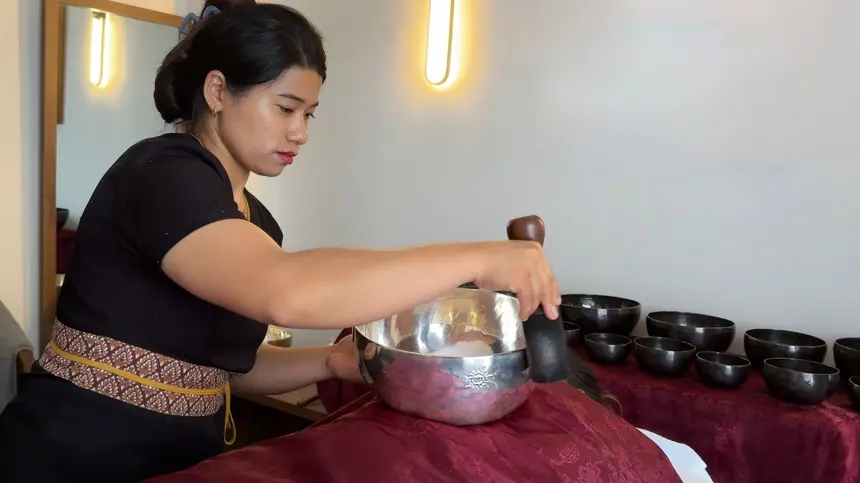
A quality instrument is an essential part of the session
The state a session leads to is set not only by the order of the notes, but by the instrument used during it. A set of seven bowls is assembled by Healingbowl® specialists like a small orchestra: they have to sound not merely good, but consonant. The specialist listens to how they combine — in key, in interval, in how one bowl sounds next to another. Then the set of seven large bowls is compared against the set of small acoustic ones. Two such sets make up the full acoustic set of fourteen, and the session becomes a weave of overtones in which the outside world recedes.
Forging a bowl and assembling a set from bowls are two different crafts, and each takes years to master. The bowl is selected by a Healingbowl® specialist so that the set sounds like a symphony. A bowl that is beautiful in itself may not fit any of the fourteen places in a set.
The massage line is a development of its own, with its own alloy and its own finishing. Reaching the required elasticity of the alloy took years of experiment with the metal and with the forging method. These parameters are intellectual property and we do not publish them. But you can see the results on video, or feel them for yourself during a session.
See the instrumentsMyths and misconceptions
Questions that sooner or later occur to anyone interested in singing bowls. We have gathered the main ones below.
- Can bowls cure?Sound and vibration affect how a person feels, and the protocols are built on that. The method does not treat disease, does not replace the help of a licensed professional and is not offered instead of one.
- The bowls are forged by Tibetan monksThe name goes back to the 1970s and to the record shops of the West: the album Tibetan Bells by Henry Wolff and Nancy Hennings, 1972, put the word Tibetan next to the sound, and traders in Kathmandu picked the label up because it sold. The craft itself is Nepalese. The bowls were beaten in the Kathmandu Valley, largely by Newar metalworkers, and served for centuries as everyday and ritual vessels — in Nepali they are simply called bata, a bowl. Nepalese craftsmen did travel north: when the Nepalese princess Bhrikuti married the Tibetan king Songtsen Gampo in the seventh century, she took Buddhist images and Newar artisans with her, and Tibetan ritual metalwork was made in Nepal for centuries afterwards. What is not documented anywhere is a Tibetan tradition of playing these bowls, or of using them to treat anyone. That use is modern, and largely Western.
- The bowls are made of seven metalsSpectrometry on one of our acoustic bowls shows bell bronze: copper and tin, with everything else under 0.15%. The alloy is chosen for decay time. Symbolism has nothing to do with it.
- The illusion of “listening” water: how a beautiful fairy tale broke against the factsIn his day the Japanese researcher Masaru Emoto enchanted the world with an elegant hypothesis: he froze water after “saturating” it with blessings or curses. The results were startling — kind words gave rise to flawless symmetrical crystals, coarse ones to shapeless blots of ice. Emoto’s books became instant international bestsellers. What stayed off camera was a thoroughly subjective method: the author selected the samples personally, knowing the history of each one in advance, and published only those photographs that fitted his theory. When the celebrated illusionist and sceptic James Randi offered Emoto a million dollars to run the experiment in the presence of independent experts, he preferred to ignore the challenge. And the companion experiment with rice, supposedly rotting from insults, failed outright when it was repeated independently — the grain proved utterly indifferent to human speech.
- Seven notes correspond to seven chakrasIt is often written that each bowl corresponds to a particular chakra. It is the phrase you hear most often from bowl sellers. The workings of our nervous system, and of the body as a whole, are extremely complex. Reducing them to seven notes is like reducing the whole spectrum of colour to the seven of the rainbow. Science and medicine keep making new discoveries about how our body works, what is written in the code of our DNA, how the pineal gland functions, and much else. It is all far more complex — and far more interesting.
The method and the trademark are registered
Authorship of sound resonance therapy was registered in 2016. The parameters of the protocol, the note sequences and the structure of a session are protected by patent RU 2862944, granted in May 2026; the international application is in progress and awaiting confirmation.
Healingbowl® is a registered trademark in six jurisdictions. Two further applications — Malaysia and Japan — have been filed and are under examination.
- United States7,003,317
- European Union018511704
- China75338331
- India6195565
- Nepal061277
- Russia882609
- Malaysiaapplication filed
- Japanapplication filed
The United States registration covers five classes, including education and wellness services. Nine further marks cover the product lines: Himalaya Pearl®, Black Pearl®, Silver Pearl®, Golden Pearl®, Surya Pearl®, Surya®, Giant Bowl Everest®, Luxury Mustang® and Old Tibet Luxury®. Scans of the certificates and of the patent are published in the documents section and are sent to partners on request.